Choose the Seychelles for variety: granite islands with mountains up to 905 m, rainforest hikes, giant tortoises and ferries between islands. Choose the Maldives for a single resort island on a flat coral atoll, with the reef off your villa and a seaplane or speedboat transfer. Both suit snorkellers; the Seychelles suits restless travellers better.
Choose the Seychelles if you want to do things between swims: climb a 905 m mountain, walk through rainforest, meet giant tortoises and take a ferry to another island. Choose the Maldives if you want one island, one resort and the reef outside your door, with almost nothing above sea level to climb.
Both are Indian Ocean island nations with warm water and white sand. The difference is the ground under your feet. The Seychelles’ inner islands are granite, steep and green. The Maldives is a chain of flat coral atolls where Wikipedia gives the highest natural ground as 2.4 m.
Seychelles vs Maldives at a glance
Sources: Wikipedia country and tourism articles, SPGA, Cat Cocos, Air Seychelles; checked October 2026.
Landscape: granite mountains against coral atolls
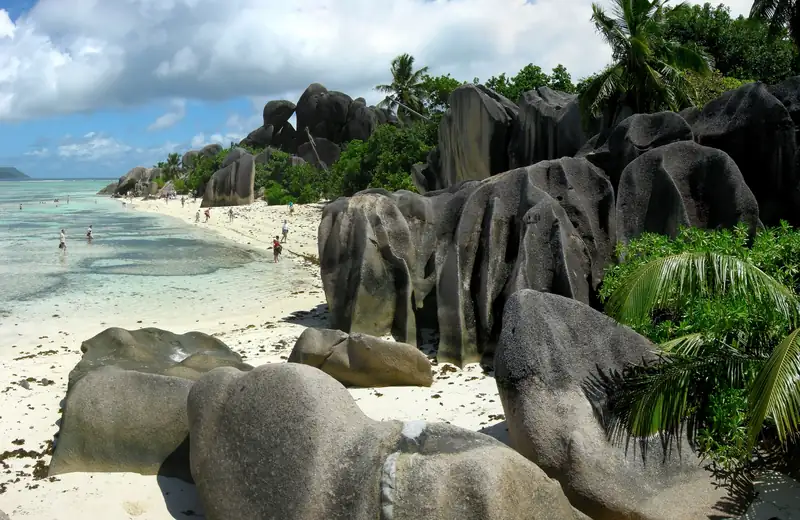
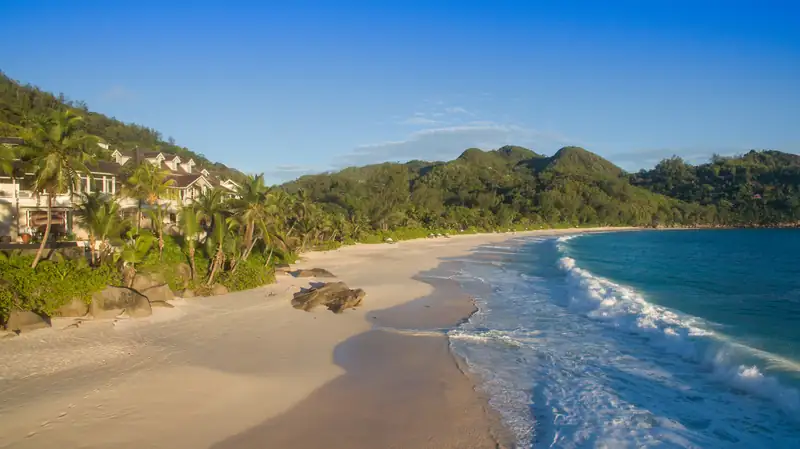
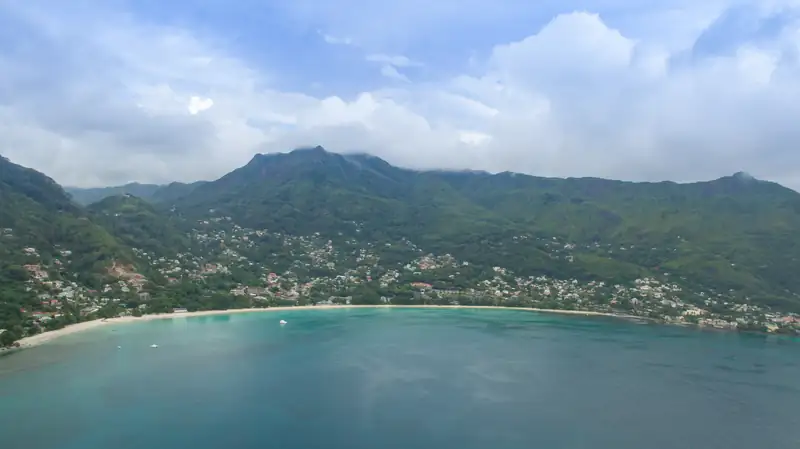
This is the biggest difference, and it shapes everything else. The Seychelles’ inner islands sit on a submerged granite block. Mahé alone is about 157 km² and climbs to 905 m at Morne Seychellois, and its national park covers more than a fifth of the island. Beaches here are framed by granite boulders, like Anse Source d’Argent on La Digue in the photo above.
The Maldives is the opposite. Wikipedia calls it the lowest country in the world. Its 1,192 islands are coral, grouped in 26 atolls, and only about 200 of them are inhabited. The views are horizontal: lagoon, reef and sky.
What you do all day
In the Seychelles, a typical week mixes water and land:
- Hike: the Copolia trail on Mahé is about 1.2 km each way, roughly an hour up, with a view over the marine park.
- See tortoises: Aldabra giant tortoises roam free on Moyenne Island, live by the hundred on Curieuse, and have an enclosure in Victoria’s botanical garden.
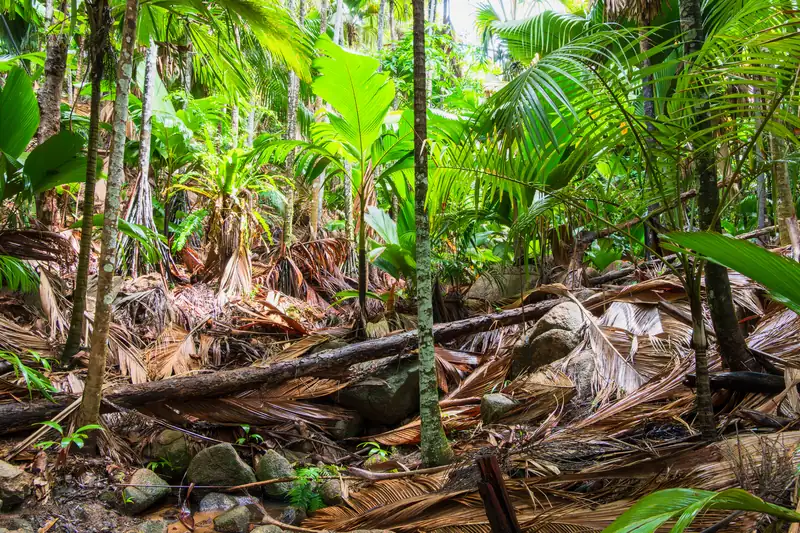
- Walk a palm forest: the Vallée de Mai on Praslin, a UNESCO World Heritage Site since 1983, is home to the coco de mer, which has the largest seed of any plant.
- Snorkel a marine park: Ste Anne, off Victoria, charges non-residents Rs 200 a day (SPGA, checked October 2026).
Our things to do in the Seychelles guide covers the rest.
In the Maldives, the day revolves around the water. Diving and snorkelling are, in Wikipedia’s words, “immensely popular”. Baa Atoll was named a UNESCO Biosphere Reserve in 2011, and Hanifaru Bay there sees some of the largest gatherings of manta rays in the world. If what you want is to step off your villa onto a reef and do little else, the Maldives model is built for that.
Getting there and getting around
Both have one main international gateway. In the Seychelles it is Seychelles International Airport on Mahé, about 11 km from Victoria. From there you are on a road network: taxis, SPTC public buses and hire cars (driving on the left).
In the Maldives, most visitors land at Velana International Airport on Hulhulé Island, next to the capital, Malé. Resorts then send a speedboat or a seaplane, depending on how far away they are. Wikipedia notes that speedboats and seaplanes are the expensive options, and the traditional dhoni boats are slower and cheaper. Velana’s seaplane terminal serves what Wikipedia calls the world’s largest seaplane operation.
Island hopping
The Seychelles makes it easy to change islands on a public timetable. Cat Cocos ferries run Mahé to Praslin in about 1 hour 15 minutes and Praslin to La Digue in 15 minutes. Economy fares were roughly €45 to €60 one way (Ferryscanner, October 2026). Air Seychelles runs up to 30 round trips a day between Mahé and Praslin. See our island hopping guide for the full picture.
In the Maldives the classic setup is “one island, one resort”, where a single hotel occupies the whole island. Hopping between resorts means booking a transfer each time. Since a 2009 rule change, guesthouses on inhabited local islands give a cheaper, more mobile alternative.
Weather
Both follow the monsoons, roughly in step. In the Seychelles the northwest monsoon runs about December to March and the southeast trades about May to October, with the calmest seas usually in April to May and October to November. In the Maldives the dry northeast monsoon turns into the wetter southwest monsoon in April and May, and the southwest monsoon lasts from June to the end of November. Our best time to visit the Seychelles guide breaks it down by month.
A note on the reefs
Go to the Seychelles with realistic hopes for the coral. The Seychelles national reef report (May 2026) put live hard coral cover on the inner islands at about 20% in 2025, after the 2024 bleaching, well below pre-2016 levels. Fish life is still good. We did not find an equally current, official figure for the Maldives, so we make no claim either way.
Where Moyenne fits
Moyenne is the kind of thing the Seychelles does and the Maldives doesn’t: a 9 to 10 hectare granite island in the Ste Anne Marine Park, about 10 minutes by boat from Victoria, where a Yorkshire newspaperman spent decades planting trees and raising giant tortoises. You can snorkel the park in the morning and walk among the tortoises after lunch, all from a base on Mahé.
The Saint-Anne Marine Park and Moyenne Island Cruise packs that into one day: a catamaran, snorkel stops, a Creole lunch and a guided tortoise walk on Moyenne, with the landing fee paid. It was from $158 on GetYourGuide, rated 4.7 from 580 reviews (October 2026). If you pick the Seychelles, start with our where to stay in Mahé guide to find a base near the boats.