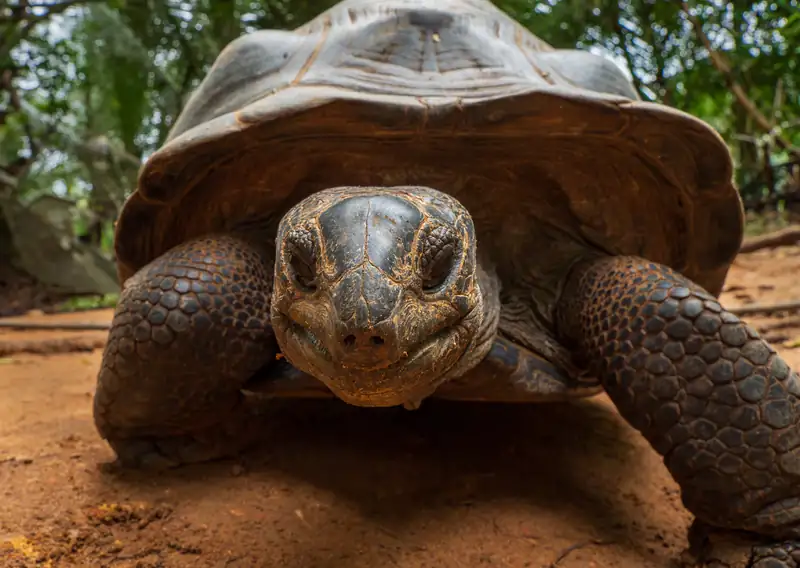
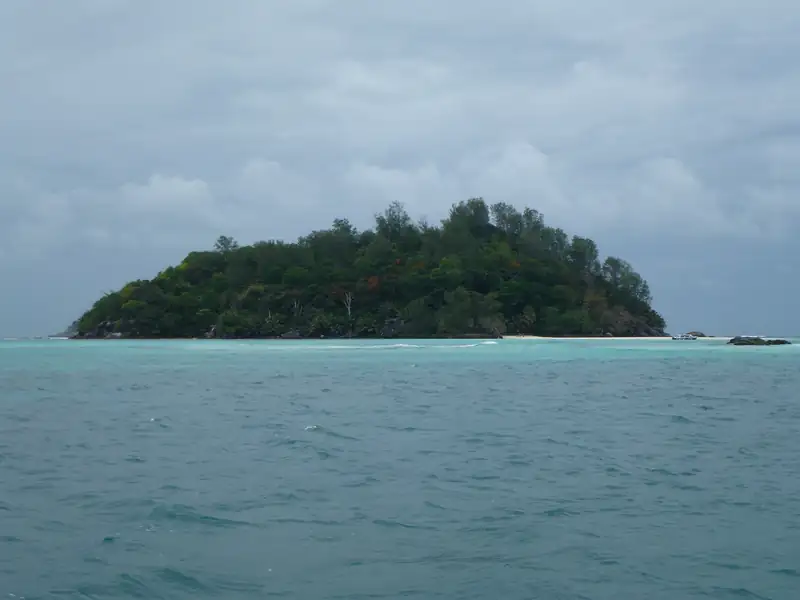
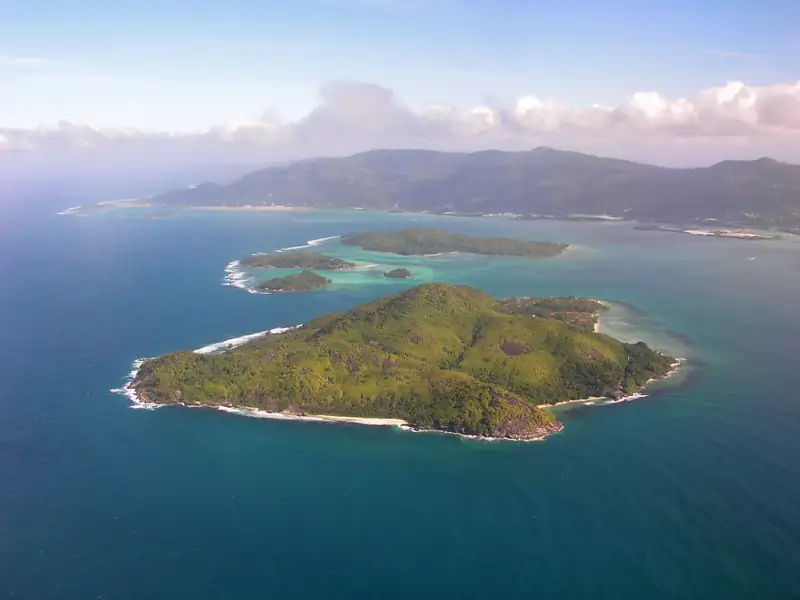
Almost every giant tortoise you meet in the Seychelles is an Aldabra giant tortoise, a species with more than 100,000 animals on Aldabra Atoll. The original Seychelles giant tortoise was thought extinct by 1840 and survives in tiny numbers. On Mahé's doorstep you can see them on Moyenne Island and in Victoria's botanical garden.
The tortoise ambling across the path in front of you on a Seychelles day trip is almost certainly an Aldabra giant tortoise, Aldabrachelys gigantea. That is true on Moyenne, on Curieuse and in the botanical garden in Victoria. The tortoise that actually evolved on Mahé and the other granitic islands, the Seychelles giant tortoise, was hunted almost to nothing two centuries ago.
The Aldabra giant tortoise
Aldabra is a raised coral atoll more than 1,000 km southwest of Mahé. It has been a UNESCO World Heritage Site since 1982 and has been managed by the Seychelles Islands Foundation since 1981. It also holds the largest giant tortoise population in the world.
How large depends on who you ask. The Seychelles Islands Foundation said in 2013 that the count had held steady at about 100,000. UNESCO’s World Heritage listing gives “over 100,000” in one place and “some 152,000” in another, and Wikipedia says about 180,000. More than 100,000 is the figure every source agrees on.
The adults are heavy. Males average about 122 cm along the shell and around 250 kg; females average about 91 cm and 159 kg. They mostly eat grasses, leaves, woody stems and fruit, and get most of their water from food because there is little fresh water on the atoll. As they browse they knock down small trees and open paths that other animals use, a role often compared to that of elephants.
They are not strictly vegetarian, either. In 2020 a female on Frégate Island was observed killing and eating a young lesser noddy, a seabird.
The name took a while to settle. Some scientists pushed for Dipsochelys dussumieri, and after a two-year debate the International Commission on Zoological Nomenclature kept gigantea in 2013.
The IUCN lists the species as Vulnerable, though that assessment dates from 1996. Trade is controlled under CITES Appendix II.
The Seychelles giant tortoise
Before European ships started calling, Mahé and the other granitic islands had giant tortoises of their own. Sailors took them in huge numbers, and by about 1840 almost every giant tortoise population in the Indian Ocean had gone. Aldabra’s survived. The domed Seychelles giant tortoise, Aldabrachelys gigantea hololissa, and the saddle-backed Arnold’s giant tortoise were both presumed extinct.
Then, in 1995, a report suggested a few might have survived in captivity. Justin Gerlach and Laura Canning of the Nature Protection Trust of Seychelles compared living tortoises with museum specimens and found animals with the features of the “extinct” form. A breeding programme started on Silhouette in 1997, and the first eggs hatched in November 2002. By 2011 it had produced about 40 young, and that April the tortoises moved to Cousine Island.
Whether this is a species, a subspecies or simply a variety of Aldabra tortoise is still argued over. Genetic studies point both ways, and many researchers treat it as part of A. gigantea. Numbers are tiny, and we could not find a reliable current count.
The most famous Seychelles giant tortoise does not live in the Seychelles at all. Jonathan arrived on St Helena in the South Atlantic in 1882, already fully grown, and lives at Plantation House, the governor’s residence. Guinness estimates he hatched around 1832 and lists him as the oldest known chelonian (the group that covers all turtles and tortoises).
How long giant tortoises live
Longer than the people who look after them, which makes ages hard to prove. Jonathan’s age is an estimate, worked back from his being fully grown when he arrived on St Helena in 1882. Adwaita, an Aldabra tortoise at Calcutta Zoo, was said to be about 255 when he died in 2006, but his early history rests on stories rather than records. Some Aldabra tortoises are thought to have passed 200, and none of those claims can be checked.
Where to see giant tortoises in the Seychelles
Moyenne Island
This is the one most visitors to Mahé can fit in. Brendon Grimshaw, the Yorkshire journalist who bought Moyenne in 1962, brought Aldabra giant tortoises to the island, numbered their shells and ran a breeding programme. Reports put the number in his care at 110 to 120. When BBC Travel visited in 2022 there were nearly 50 free-roaming adults, with hatchlings kept in two nurseries. We could not confirm a current count.
You see them on the trail that loops round the island, often right on the path. Moyenne is in the Ste Anne Marine National Park, 10 to 15 minutes by boat from Victoria, and you reach it on a day tour. The Saint-Anne Marine Park and Moyenne Island Cruise includes a guided walk among the tortoises and the landing fee. Our guide to visiting Moyenne has the details, and the Brendon Grimshaw page tells the story of how the tortoises got there.
National Botanical Garden, Victoria
The garden at Mont Fleuri, on the edge of Victoria, was founded in 1901. SPGA calls its giant tortoises the garden’s “most popular attraction”, and you are allowed to feed them. It is open daily from 8am and costs Rs 250 for non-citizens (SPGA, checked October 2026); SPGA’s own pages disagree on whether it closes at 4.30pm or 5pm. This is the cheapest and easiest option if you are on Mahé without a boat trip. See our Victoria guide.
Curieuse Island
Curieuse, about 2 km off Praslin, has what SPGA calls “hundreds of Giant Tortoises”, introduced between 1978 and 1982. It runs a nursery where young tortoises are raised until about five years old and then released. Boats take about 20 minutes from Côte d’Or on Praslin. It is also the only place apart from Praslin where the coco de mer palm grows wild. If you are planning a trip to Praslin, our island hopping guide covers the logistics.
Cerf Island
Some Ste Anne Marine Park trips that do not land on Moyenne show visitors tortoises on Cerf instead. If tortoises matter to you, check the itinerary says where.
Aldabra
The largest population on Earth, but Aldabra is more than 1,000 km from Mahé. The Seychelles Islands Foundation allows only limited, pre-authorised visits booked through a tour operator, so it is an expedition rather than a day trip.
Smaller populations also live on Frégate, a private island, and on Aride, where conservationists released 50 young tortoises to join 10 larger ones rehomed there earlier.
Visiting them well
Tortoises are wild or semi-wild on Moyenne and Curieuse. Give them room on the path, keep your hands off their heads, and follow what the guide or ranger tells you about touching and feeding. On Moyenne the hatchlings in the nurseries are part of a breeding effort, so look but do not lift.