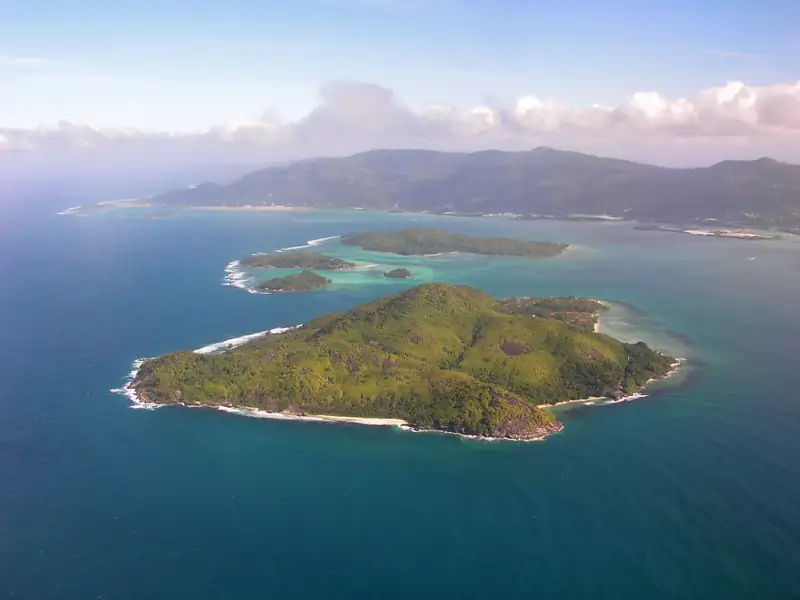
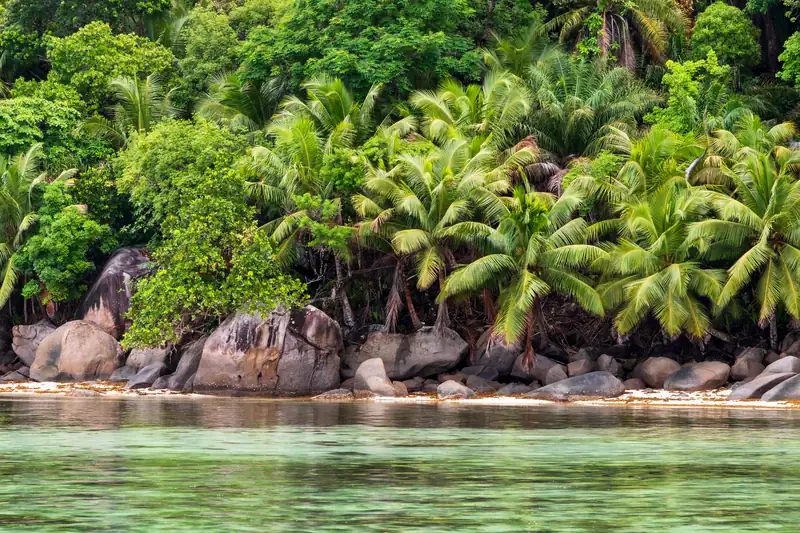
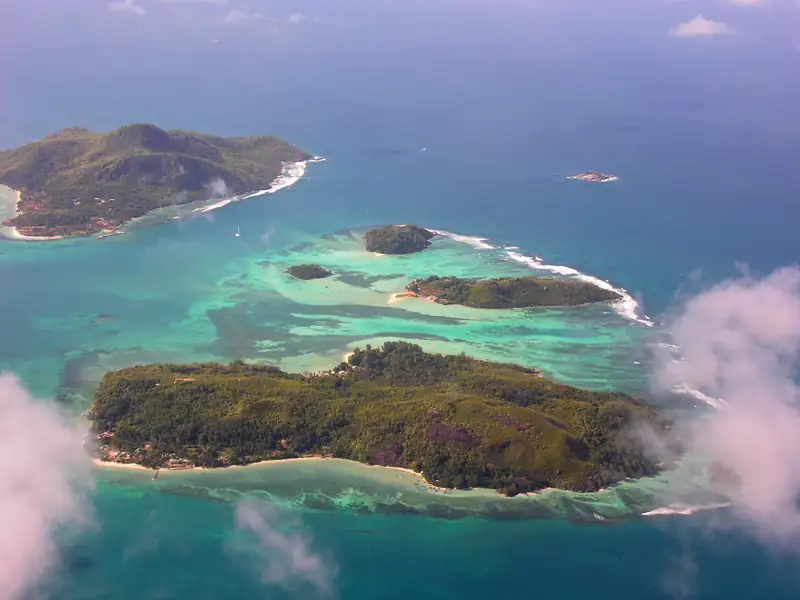
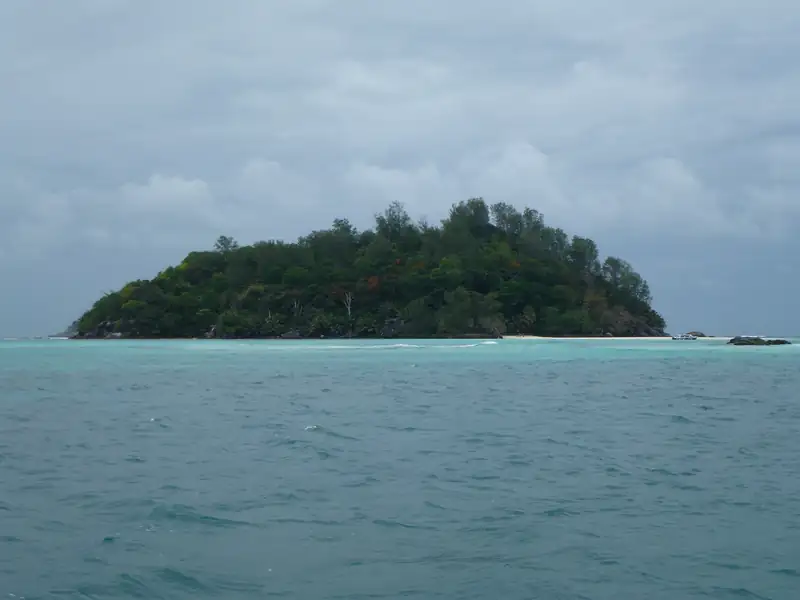
Sainte Anne Marine National Park is a protected area of sea and six islands about 5 km off Mahé, a 10-minute boat ride from Victoria. Declared in 1973, it was the first marine park in the Seychelles. Day trips snorkel its reefs and usually land on Moyenne or Cerf. Non-residents pay Rs 200 a day.
Sainte Anne Marine National Park (you will also see Ste Anne and St Anne) covers 14.53 km² of sea and islands just off Victoria, the capital of the Seychelles. It was decreed on 19 March 1973, the first marine protected area in the country and one of the first in the Indian Ocean. More than 28,000 paying visitors came in 2024, according to SPGA, the Seychelles Parks and Gardens Authority that runs it.
Six islands sit inside the park. Two of them take day visitors. The rest are resorts, a closed former prison and a bird reserve, which is why most day trips follow the same pattern: snorkel in the morning, lunch on Cerf or Moyenne, walk Moyenne’s trail, and back to Mahé by late afternoon.
Where is Sainte Anne Marine Park?
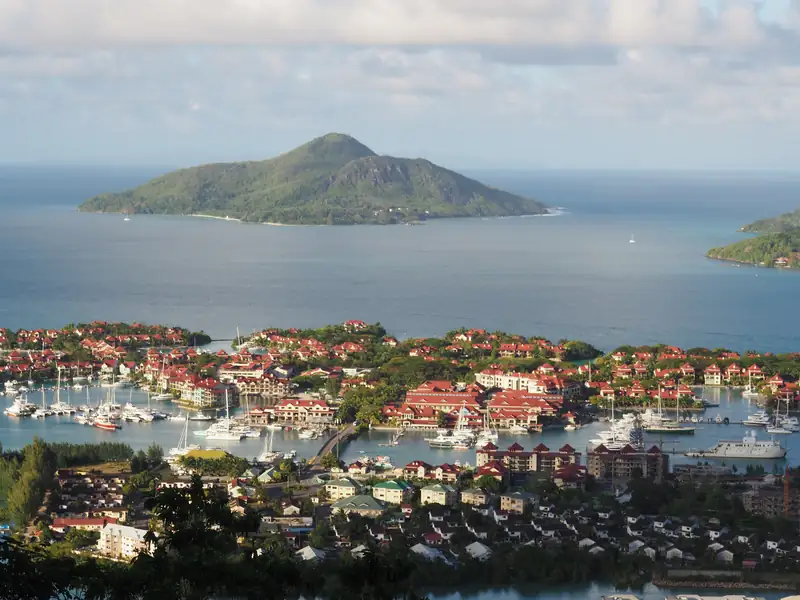
Off the northeast coast of Mahé, between Victoria’s harbour and the open sea. SPGA puts the park about 5 km from Mahé and calls it a 10-minute boat ride from Victoria. From the top of the Copolia trail above town you look straight down on its islands. Our Mahé map shows the islands, the departure points and the airport.
One naming trap: Ste Anne is the park’s largest island, but Baie Ste Anne is the jetty on Praslin, about 45 km northeast of Mahé, where some Cat Cocos ferries dock.
What the park is famous for
It was the first marine park in the Seychelles. It holds Moyenne Island, the tiny national park where Brendon Grimshaw planted a forest and raised giant tortoises. And it is easy snorkelling: SPGA calls it “a perfect snorkeling spot”, with one of the largest seagrass meadows in the granitic islands, where green turtles feed. Hawksbill turtles nest on Ste Anne, and bottlenose dolphins are sometimes seen.
Visiting the park
Boats leave from the Marine Charter area and Inter-Island Quay in Victoria and from Eden Island Marina. There is no public ferry, so you go on a tour or charter a boat. If you want one day that covers the reef and Moyenne, the Reef Safari with lunch pairs a semi-submersible and a snorkel with an afternoon ashore on Moyenne.
Fees and hours
Checked October 2026, from SPGA’s visitor information page:
Entry is not free for visitors aged 12 and over; we found no source saying otherwise. The park’s own page on the SPGA site still says 9am to 5pm, so if you plan an early start, check with your operator. Tour packages usually include the park fee; some include the Moyenne landing fee and some do not, so read the listing.
The rules. No fishing, spear guns or traps. No collecting shells, coral, plants or marine life. No water-skiing or motorised water sports, and boats anchor only in designated areas. SPGA’s own line is to leave nothing but footprints and take nothing but photographs.
Our how to visit guide covers departure points, the trip from the airport, timings and what to bring.
Moyenne Island
Moyenne is the reason many people book a marine park trip. It is a small granite island of about 9 to 10 hectares that the British journalist Brendon Grimshaw bought in 1962 and spent the rest of his life replanting with René Antoine Lafortune. They planted about 16,000 trees, brought in Aldabra giant tortoises and cut a trail round the island.
It was agreed as a national park in 2008 and formally declared in 2009. BBC Travel and others often call it the world’s smallest national park, though there is no official ranking behind that. A foundation runs the island; SPGA runs the sea around it.
On a visit you walk the loop trail past free-roaming tortoises, Grimshaw’s grave, two old graves that legend links to pirate treasure, a small chapel and a museum. Lunch is at the Jolly Roger, the island’s only restaurant.
Ste Anne Island
Ste Anne is the largest island in the park at about 2.2 km², with a hill that rises to 246 m. The first French settlement in the Seychelles was here, in 1770. Whalers used it in the early 19th century, and the Royal Marines had a base on it in the Second World War.
Today it belongs to Club Med Seychelles, which opened at the end of March 2021 in the former Beachcomber resort after a €70 million refit. SPGA says the island is occupied by a hotel and access is restricted, so it is closed to day visitors and tours stay offshore. Hawksbill turtles nest on several of its beaches, including Grand Anse, Petit Manon and Anse Cimitière, and those beaches are off-limits to everyone. More in our Ste Anne Island guide.
Cerf Island
Ile aux Cerfs is the second largest, at about 1.3 km² with a high point of 108 m. It is named after the French frigate Le Cerf (1756), and it has a small resident population.
Cerf is where most day trips stop for lunch. It has the Cerf Island Resort (which only accepts children over 7), L’Habitation and Fairy Tern Chalets, and restaurants including the Kapok Tree. Some tours also show visitors giant tortoises on Cerf. Currents can be stronger around Cerf than elsewhere in the park, so stay close to your guide when snorkelling there. See our Cerf Island guide for what to do there and how to get across.
Round Island
There are two Round Islands in the Seychelles, and search results often mix them up. This one, Ile Ronde, sits in the marine park off Mahé. The other lies about 550 m off Praslin’s southeast coast, about 48 km northeast of Mahé.
The marine park’s Round Island is tiny, about 0.018 km², with a darker history than its size suggests: it held a leprosy settlement, and women with leprosy were moved from it to Curieuse in 1940. A Seychellois family bought it in 2005, and the Enchanted Island Resort opened in December 2013. Marriott lists the resort and JA Resorts also markets it, and its Booking.com listing showed as closed when checked in October 2026. Like Ste Anne, it is closed to day visitors. Some tours walk the sandbank near Round and Long islands instead.
Long Island
Ile Longue covers about 0.21 km². Its village was abandoned around 1900 for a smallpox quarantine station, and the island later held the state prison until the inmates were moved to Montagne Posée on Mahé in 2006.
A resort project stalled, and in January 2024 the government took the island back and chose a UAE company, Al Sharqia Holding, for a 99-year lease to build a new resort. We could not confirm what has happened since, so do not count on landing there. One semi-private snorkelling tour on GetYourGuide lists a break on the Long Island sandbank, so ask the operator what that involves.
Ile Cachée
The smallest island, Ile Cachée, is about 5 acres (0.021 km²). It is a nature reserve with noddy colonies, and its dive site can only be used during the northwest monsoon. None of the day tours we looked at land there.
Snorkelling in the park
The reef between Moyenne and Ste Anne is often named as the best snorkelling area in the park, with Cerf’s reefs second. That ranking comes from tour operators and travel sites rather than any survey. Tour snorkel stops report parrotfish, angelfish and the occasional hawksbill turtle.
Be realistic about the coral. The 2024 global bleaching event reached the inner islands by April that year, and the national reef status report published in 2026 put live hard coral cover around the inner islands at about 20% in 2025, well below the levels before 2016. We found no figure for Ste Anne alone. The fish are still there in numbers; much of the coral is recovering.
If you want to see the reef without swimming, glass-bottom boats and a semi-submarine from Eden Island cover the same water. More on gear and spots in our Seychelles snorkelling guide.
When to go
Snorkelling is usually best when the sea is calm, which tends to mean April to May and October to November. Travel sites put the hawksbill nesting peak on Ste Anne at roughly November to February; SPGA keeps the nesting beaches closed to visitors. See the best time to visit the Seychelles for the full year, and where to stay in Mahé if you want a base close to the boats.